Originally published in Board Coverting News.
For more than 70 years, Bay Cities has built its reputation as a leader in packaging and retail display manufacturing, helping brands stand out in increasingly competitive retail environments. Headquartered in Los Angeles with facilities across the United States, the company operates in a business defined by high expectations, tight timelines, and growing operational complexity.
That longevity has not come from standing still. It has come from continuously evolving, not just in materials or production capabilities, but in how the business runs day to day.
Over time, that evolution led to a more fundamental question: How can we better understand what is happening inside the plant in real time and act on it before performance is impacted?
The answer, for many corrugated converters, is not more data, but better data and the ability to turn it into action.
That is where the role of a capable partner becomes critical. Bay Cities recognized early that moving forward would require not only a clear vision internally, but a supplier with the expertise to support data collection at the machine level and integrate it into a broader system.
While there are many digital solutions available, not all are built with the realities of corrugated converting in mind. Implementing this type of system requires a partner that is both nimble enough to evolve with the operation and experienced enough to understand the specifics of box making.
Bay Cities partnered with SUN Automation Group to make that happen. With over 40 years in the corrugated industry, SUN leveraged its deep understanding of converting equipment, plant operations, and the realities of the production floor to develop Helios. As an industrial Internet of Things (IIoT) platform, Helios is designed to capture, interpret, and act on machine-level data across the plant.
Building a More Connected Operation
Greg Tucker, Chairman and CEO of Bay Cities, describes the company’s objective as straightforward: create a more connected and responsive environment across the plant.
“We were looking at how to make our operations more intelligent,” Tucker says. “The idea was that Helios could become the octopus of the plant, with tentacles reaching into the machines so we can understand what is actually happening on the floor.”
The goal was not simply to collect machine data for its own sake, but to translate those signals into action. In practice, that meant using machine data to anticipate issues before failures occur.
In a fully connected system, machine data would identify when components begin to break or wear, allowing maintenance teams to act before failures occur.
“That information would flow into our maintenance systems, parts get ordered automatically, and we schedule the repair before it becomes a production issue,” Tucker explains.
While that level of automation is still evolving, the foundation is now in place. Bay Cities and SUN have established a critical first step: building a reliable foundation of machine-level data.
From Signals to Action
Helios is designed as a machine-agnostic platform, allowing converters to monitor equipment across the plant, regardless of manufacturer.
For Bay Cities, the value is not just in visibility, but in how quickly that information can be used.
“AI is helping us be more efficient,” Tucker says. “We’re making smarter, faster decisions with it. The key is identifying the right data and the right moments to act, and then using that information to its fullest potential.”
In practice, that means shifting away from relying on operator intuition or delayed reporting and toward a clearer, more immediate understanding of what is happening on the floor.
According to Gokul Gopakumar, Vice President of Technology and Business Development at SUN Automation Group, that shift depends on capturing the right signals at the source.
“What we have built so far is the base layer of information coming from the machines,” Gopakumar says. “Once you have consistent and reliable data, you can begin connecting that information to maintenance systems, production planning, and how teams respond to issues in real time.”
The difference is not the volume of data. It is the ability to filter out noise, focus on what matters, and act before performance is impacted.
Where Implementation Becomes Real
Like most operational technology initiatives, progress is not immediate. At Bay Cities, implementation required patience, iteration, and a willingness to work through early challenges before the system could deliver value.
The first step was establishing reliable machine data.
“In the beginning, we had a sensor issue,” Tucker recalls. “Once we solved that and finally connected the machine and started receiving reliable responses from Helios, we knew we had something real.”
That moment marked the shift from concept to capability. With consistent signals in place, the focus moved to making sense of the data and determining how it could be used for making daily decisions.
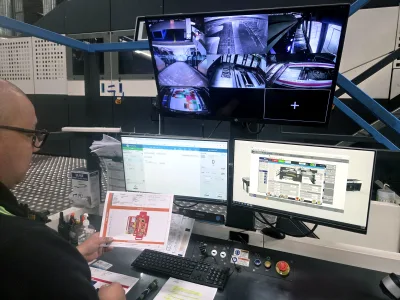
It is now beginning to show up in day to day operations. During one production run, a warning was generated by Ignition, a system connected to the machine’s controls that monitors real time performance. Helios, using its own sensors to read conditions directly from the equipment, confirmed the issue. Together, the systems identified that a critical bolt inside the machine was beginning to loosen. If left unaddressed, the failure could have led to severe internal damage and unplanned downtime.
“If we didn’t catch it, that bolt would have come undone and a shaft would have sailed through the machine,” Tucker says. “That’s the real world. That’s machines and systems working together to say, ‘stop the car.’”
The next challenge was maintaining momentum. Implementing a system like Helios is not a one-time deployment. It requires ongoing alignment across operations, engineering, IT, and leadership to ensure the technology continues to evolve alongside the business.
At Bay Cities, that alignment was driven from the top.
“You have to stay committed to the vision,” Tucker says. “Manufacturing environments are busy, and people get pulled in a lot of directions, but if you believe the technology can improve the operation, you have to keep pushing forward.”
Sustaining that progress requires discipline.
“What used to take months now happens in weeks,” Tucker adds. “If we want to stay competitive, we have to move faster.”
Refining the System
That pace is now shaping how the system continues to evolve. The partnership between Bay Cities and SUN has become an ongoing process of iteration, with each phase building on what was learned in the last.
“We’ve learned a great deal through the collaboration with Bay Cities,” Gopakumar says. “Each step has helped us refine the platform and understand how it can better support plant operations.”
One of the current focus areas is improving machine-level sensor integration to capture more precise and actionable signals.
“We are identifying where the gaps in machine data exist,” Gopakumar says. “That’s where sensors become important. They allow us to capture signals that were previously unavailable.”
Those insights are also shaping how SUN continues to approach sensor integration within the Helios platform, with a focus on improving signal reliability and overall data quality in corrugated converting environments.
More consistent and accurate signals help improve predictive models and reduce false alerts, two of the most persistent challenges in industrial analytics systems.
A Shift in How Plants Operate
For Bay Cities, the impact of Helios is not defined by a single outcome, but by the foundation it creates. Greater visibility leads to earlier intervention, which in turn supports more informed decision-making across the plant. Over time, those incremental improvements begin to compound, strengthening overall performance and consistency.
For the industry, the implication is broader. “Technology like this shouldn’t only be available to the largest companies,” Tucker says. “Smaller converters should be able to use the same tools to improve efficiency and compete.”
SUN shares that perspective.
“Our goal is to help converters operate more intelligently,” Gopakumar says. “When machine data and analytics work together, plants can move from reacting to problems to anticipating them.”
As more converters begin exploring digital strategies, the experience at Bay Cities highlights a practical reality: transformation does not happen all at once. It starts with better data, improves through better decisions, and ultimately depends on the discipline to act on what the data reveals.
 Manufacturing Safety: Where Equipment, Process, and Training Failures Actually Start